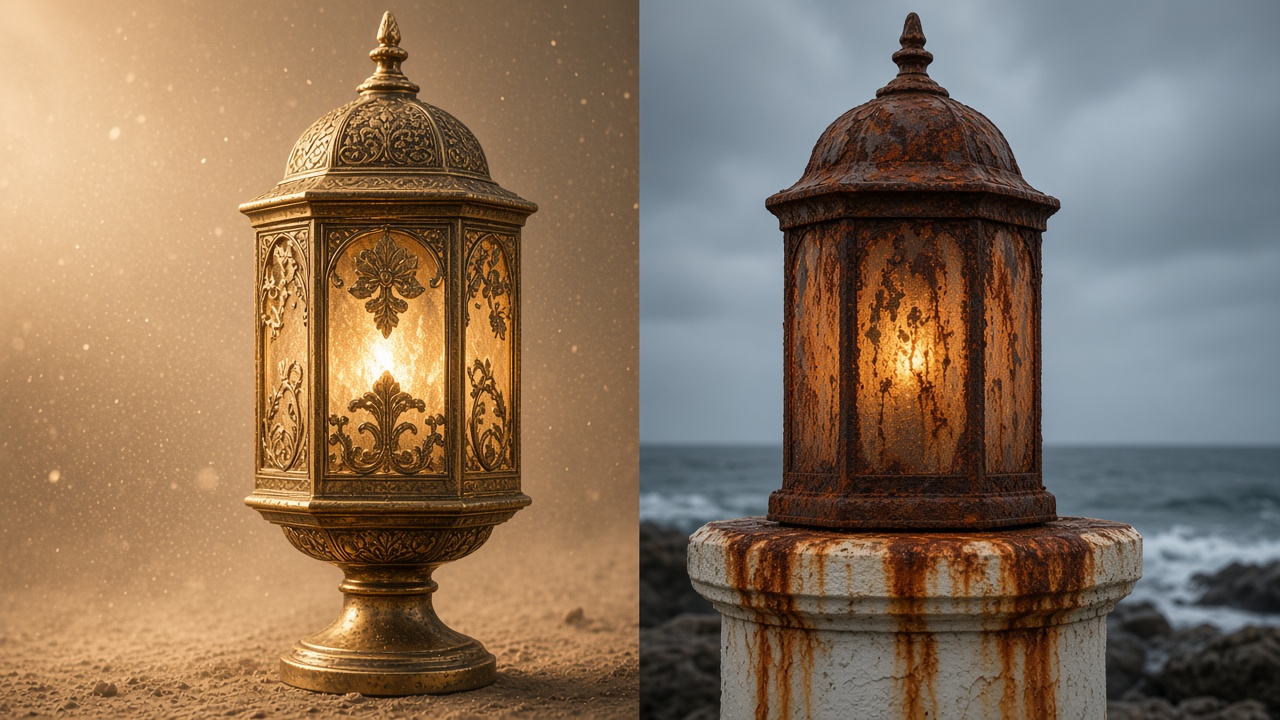
Cast aluminium. Iron rusts once moisture gets past its coating, and within two or three years it leaves orange stains down the pillar. Aluminium doesn't rust. It forms a thin, stable surface layer, so in our workshop experience a cast aluminium gate light runs for fifteen to twenty years. It costs roughly 20 to 40 percent more than iron up front and works out cheaper over ten years. Check that it is cast and not thin aluminium sheet. Real cast aluminium is heavy, with crisp edges on the detail.
I get this question at least twice a week, usually from someone who bought iron lights three years ago and is now looking for replacements. This is the answer from people who have spent 35 years watching what happens to both materials outside, monsoon after monsoon.
Why iron lights fail
Iron is strong, but it oxidises the moment moisture reaches it, and outdoor lights deal with moisture constantly: monsoon rain, morning dew, hosepipe cleaning and coastal salt air. In the first year an iron light looks fine and the powder coating holds. By year two or three you see orange stains running down the pillar below the fitting, and by year five the rusting is structural.
The powder coating applied to protect the iron traps moisture once it starts to crack or chip. At that point the light rusts from the inside, and nothing short of replacing it fixes it.
Why aluminium doesn't
Aluminium is naturally corrosion resistant and doesn't need a coating to survive outdoors. The coating on our lights is cosmetic, not a protective barrier. Even if the finish chips after years of UV exposure, the aluminium underneath doesn't rust. It oxidises very mildly on the surface and forms a stable layer that protects the metal further. That is why we've worked in cast aluminium since we started in 1990.
What it costs
An aluminium gate light typically costs 20 to 40 percent more up front than an equivalent iron fitting. Over ten years the calculation changes. One aluminium light that, in our experience, runs for fifteen to twenty years has to be compared with two or three iron replacements in the same period, plus the labour to remove and reinstall each time and the repainting of rust stains on your pillar. The aluminium pays for itself well before you would buy a second iron fitting.
Fifteen to twenty years is the run we've watched in the workshop since 1990. It is not a certified life test, and we haven't published one.
What to check when buying "cast aluminium"
"Cast aluminium" is sometimes used as a label for lights fabricated from thin aluminium sheet, not cast in a mould. They are lighter, thinner and far less durable, and they look similar in a catalogue photograph.
Real cast aluminium has weight. Pick it up and it should feel solid, and the details (finials, scrollwork, lattice, grilles) should have crisp, clean edges, not pressed curves. If a gate light weighs almost nothing, it is probably not cast aluminium in the traditional sense. A photograph can fake both the weight and the edges, but your hand can't.
Sand casting and die casting
The works began in 1990 as a sand-casting shop in Premier Nagar. The About page records the shift: the catalogue range we specify on drawings today is die-cast, which is what gives the weight and the crisp detail that sheet fabrication doesn't. Sand-cast pieces still exist in the city around us.
Where this choice shows up in the catalogue
The same body decision applies to wall lanterns, hanging lights and pole lanterns, not only the gate lights range. A pole on a drive and a head on a pillar see different amounts of splash, but neither is an indoor fitting with an outdoor name. How coastal salt and inland dust treat the finish is in powder coat and antique, and what July rain does to a hinge that doesn't latch is in the monsoon note.
If you're holding a piece and you're unsure what it is, send a photo on WhatsApp at +91 70176 62533 and we'll say what we think it is. Prices and codes are in the catalogue PDF, and billing terms are on About.