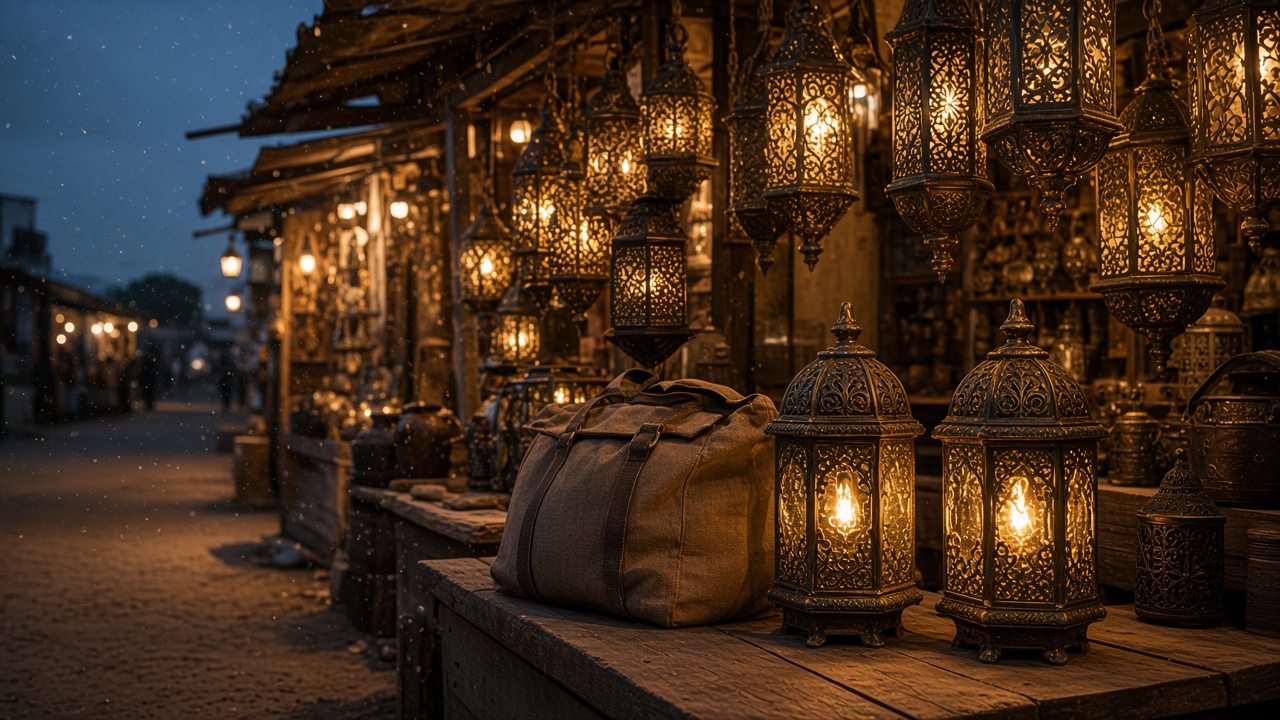
This trip started badly. My sample lights, the ones I needed to show dealers in Bangalore, got delayed. They finally reached me on the exact day I had to leave the city. So my big market visit to Bangalore happened with nothing but a catalogue on my phone and a lot of hand gestures describing what "sand-cast" and "IP65" mean to someone who has never heard those words before.
From there I went to Hyderabad, stayed two days, and this time I had physical pieces with me: a mix from our sand-cast range and our die-cast range, one suitcase in total. The die-cast pole light, the one that extends up to 12 feet, got more attention than anything else I carried. Dealers who normally just check weight and finish kept coming back to it, asking how tall it goes and how it breaks down for transport. Every dealer on Troop Bazar wanted to hold these pieces, turn them over, tap the metal and check the weight. A photo, a video call or a spec sheet can't do what five seconds of a dealer's hand on real cast aluminium does.
I came away from Hyderabad with an order, and what I heard while walking these markets, city after city, was worth more. I want to write it down because I think every quality manufacturer in this country needs to hear it.
Bangalore: Kilari Road and the B.V.K. Iyengar Road cluster
Kilari Road, B.V.K. Iyengar Road and the lanes running off Chickpet are where decades-old lighting and hardware businesses sit shoulder to shoulder, family shops that have traded fixtures since before some of their customers were born. It's dense and loud, the way old Indian trade markets are, and everyone knows everyone. Reputation travels faster than any advertisement.
Even without my samples, walking that stretch showed me where demand has moved.
Hyderabad: Troop Bazar and New Osman Gunj
Troop Bazar is Hyderabad's answer to Kilari Road, the address every electrical and lighting dealer in the city either sits on or sources from. A few lanes over is New Osman Gunj, a second cluster doing the same trade, and out in Secunderabad R.P. Road has its share of lighting and electrical stockists too. This is where I finally got to put a real light in someone's hands. Two days, three products, and conversation after conversation that ended in the same place.
What the mid-market is buying
Across every city I visited, the dealers who are still honest with themselves told me the same thing: China has taken over the mid-market. Acrylic lights, mild steel and thin-gauge iron are cheap, light, fast to produce and priced so low that a genuine cast aluminium piece looks expensive next to them on the same shelf, even though the aluminium piece will outlive the cheap one many times over.
Buyers know it won't last, and for many that is almost the point. They want to change their look fast, refresh their gate or their balcony every year or two, and they have decided that's cheaper to do with a ₹400 acrylic fitting than a ₹1,800 aluminium one built to last fifteen years. Nobody is thinking about what an Indian monsoon does to mild steel in year two. They are thinking about what looks good in this year's photos.
I'm not saying this bitterly. A manufacturer needs to understand his market, and complaining about it doesn't help.
What Indian weather does to cheap lights
Mild steel and thin iron do not survive an Indian outdoor season without real protection. Humidity, monsoon exposure and temperature swings eat through cheap coatings within a year or two. Acrylic yellows and turns brittle under UV within a couple of summers. These are not durability claims from a competitor talking down another material. Any dealer who has taken returns on this stuff will tell you the same.
Cast aluminium done properly (sand-cast, LM6 alloy, powder-coated correctly) doesn't have this problem, which is why housing societies, hotels and serious builders still specify it while the retail market chases cheap and fast.
Delhi: Bhagirath Palace
Bhagirath Palace in Chandni Chowk is India's largest and most famous wholesale electrical market, the benchmark every other city's market gets compared to. I've done business here on separate trips, and the pattern holds: huge volume, huge price competition, and the same story of cheap imports squeezing quality manufacturers out of shelf space.
Gurugram, Noida and Ghaziabad: the NCR showroom shift
These are newer, more showroom-driven markets than Delhi or Hyderabad, and more influenced by what architects and interior designers specify for villas and gated communities. Demand skews more premium than in the old-city markets, which is encouraging for a quality manufacturer. Buyers in this segment are more likely to ask about alloy grade and IP rating before they ask about price.
Ahmedabad and Kodaikanal: different markets, same lesson
Ahmedabad's trade instincts are sharp. Gujarati business sense doesn't miss value, and once you can show that a product lasts longer, the maths sells itself. Kodaikanal was a different kind of trip, smaller and more resort and villa driven, where buyers care a lot about how a fitting looks against hill-station architecture. Even there, the same tension exists between what looks good today and what lasts through a hill-station monsoon.
Who still buys a casting
In a smaller but more loyal market than the one we used to have. We are not going to out-price a Chinese acrylic import, and I've stopped trying. We can be the clear answer for the buyer who has already been burned once: the housing society that replaced its cheap gate lights after two monsoons and doesn't want to do it again, the hotel that can't afford a fitting failing during a guest's stay, the builder whose reputation depends on the RWA never calling about broken lights.
That buyer exists in every city I visited. They are harder to find than they used to be, buried under a much bigger crowd chasing this month's cheapest option. Finding them, and being visibly the quality choice when they come looking, is what we have to get right.
If you're a dealer, architect or builder who's tired of replacing what you bought two years ago, we'd like to show you what fifteen years of the same fitting looks like. Reach out on WhatsApp, and if you're anywhere near one of these cities, there's a decent chance I've already walked your street.