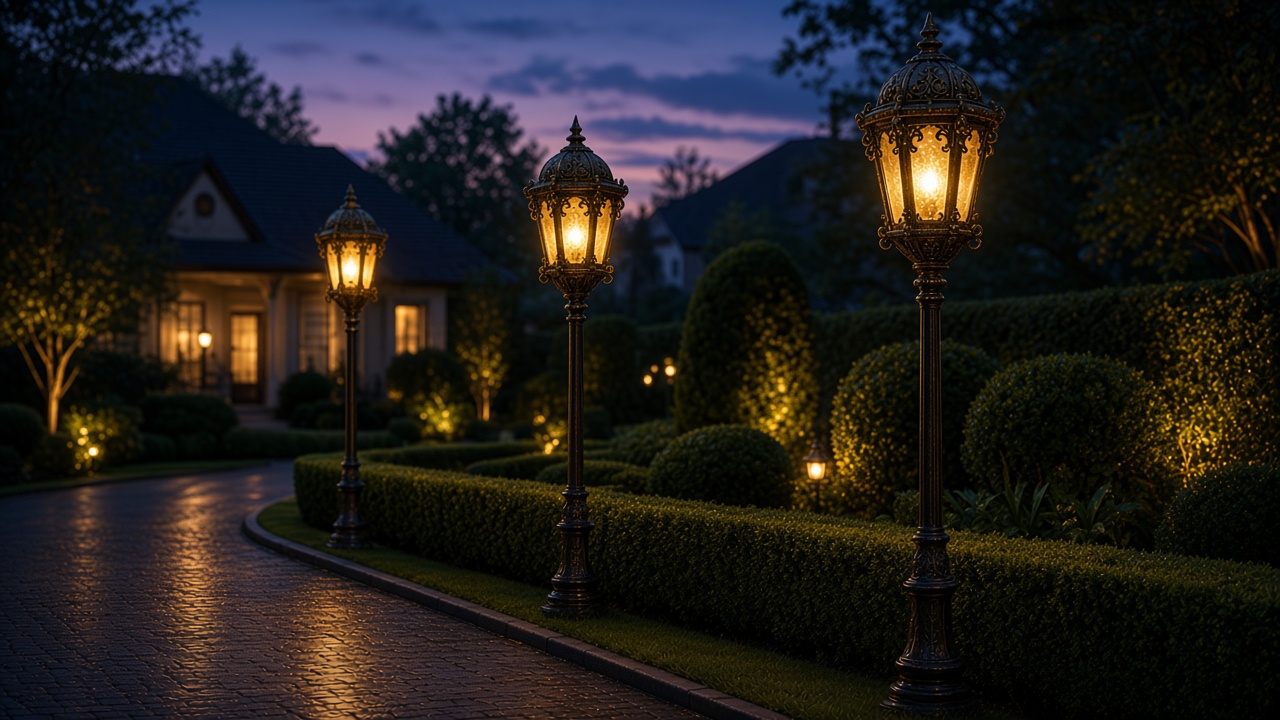
A driveway lined with pole lanterns is one of the most striking things a home can have. Done right, it transforms an ordinary entrance into something that stops people in their tracks. Done wrong — wrong height, wrong finish, wrong spacing — it looks more like a car park than a home.
We've been making outdoor pole lanterns in Aligarh since 1990. In that time, we've supplied them to bungalows, farmhouses, five-star hotels, housing societies, and heritage properties across India. Here is what we've learned about what actually works.
Height first — everything else follows
The most critical decision for a pole lantern is height, and most people get it wrong by going too short. A pole lantern that's only four feet tall looks like it belongs in a garden path, not a driveway. For a main driveway or entrance, the minimum you want is six feet — ideally eight to ten feet for a property with any scale to it.
The rule we give every customer: the pole lantern should be roughly 1.5 to 2 times the height of the wall or boundary it runs alongside. If your compound wall is five feet, your pole lanterns should be at least seven to eight feet. This creates visual continuity rather than a random height relationship between the light and the structure.
For internal garden paths or walkways between buildings, shorter is fine — four to five feet is common. But for the main drive, go taller than you think you need.
Spacing: the rule of three cone widths
Most people space their pole lanterns too far apart. They think about the cost and stretch the spacing to use fewer lights. The result is pools of light with dark gaps between them — which looks worse than a single light at the entrance would.
The principle: each pole lantern should illuminate the ground in an overlapping cone with its nearest neighbour. For an eight-foot pole with a standard lantern head, this means poles spaced no more than 12 to 15 feet apart. For shorter poles, close the spacing further.
If budget is a constraint, use fewer poles but cluster them intentionally — three at the gate, two at a turning point — rather than spreading them thinly along the full length of the drive.
Cast aluminium, not iron or steel
For any pole lantern that will spend its life outdoors in India, the material choice is straightforward: cast aluminium. Iron rusts. Galvanized steel loses its coating in five to seven years in humid climates. Cast aluminium does neither — it forms a natural oxide layer that protects it permanently, without paint, without treatment, without replacement.
We know this because we still get calls from customers who bought Padma pole lanterns in the late 1990s. They're calling for replacement bulbs. Not replacement lanterns.
Finish: matching the property, not the catalogue photo
Antique gold and antique copper are the two finishes that work in almost every Indian property context. They're warm, they complement both traditional and contemporary architecture, and they age gracefully. Matte black is a strong third option for purely contemporary homes — especially with flat-roofed modern architecture.
What doesn't work: a mirror-polished finish for anything in direct outdoor exposure. It shows every drop of hard water, every dust streak, every fingerprint from the installation team. Choose a textured or matte finish and you'll never need to polish it.
The lantern head: proportion matters more than style
The most common proportion mistake we see in the field: a thin pole with a lantern head that's too small to read at a distance. The lantern head should be wide enough to anchor the top of the pole visually — typically at least 30% of the pole's width for a stable proportion, and the head height should be roughly 20–25% of the total pole height.
So for a 10-foot pole, your lantern head should be at least 24 to 30 inches tall, with a diameter of 10 to 14 inches. Anything smaller disappears at scale — you'll end up with what looks like a broomstick with a thimble on top.
Questions to answer before you order
- What is the total length of the driveway or path you're lighting?
- What is the height of the compound wall or boundary alongside it?
- Is this for a main drive, a garden path, or an internal corridor?
- What is the architectural style of the property — traditional, contemporary, or colonial?
- Will the poles be freestanding or wall-mounted at the base?
- Is underground wiring already in place, or does it need to be laid?
"A well-lit driveway doesn't just illuminate a path. It announces that someone thoughtful lives here."
Send us a WhatsApp message with a photograph of your driveway or garden space and your compound wall height — we'll recommend specific models, heights, and spacing for your situation. No guesswork, no generic catalogue answer.