Plain plaster and a flat slab canopy over the gate leave little room for a domed lantern covered in scrollwork. When the drawing looks like that, architects ask the Aligarh works for pillar heads with straight sides and a flat or shallow top. The answers below use codes from the Padma range. Sizes are copied from each product page and read as height by width in inches. The complete set of post-top models, plain and ornate, is on the gate lights page.
Which gate codes have a square outline?
Four post-top castings in the current range are built on a square plan. Two of them are low boxes, wider than they are tall. PGL 1099 has a flat lid that overhangs its frosted panels, with diagonal bars running across the glass, and comes in 11×11 and 9×9. PGL 1066 has a shallow pyramid roof over panels cut in a stepped fret pattern, at 10×11 and 9×8. Both are listed in Raw Grey. Seated on a broad cap, either one reads as a lit extension of the masonry.
The other two stand upright. PGL 1060 is a slim tower that tapers from a wide foot to a flat lid, with tall glass on all four faces. It is listed in Matte Black at 14×9 and 9×5. PGL 1103 is taller, at 22×10.5 or 17×10, with perforated jaali panels and a pointed top. That pointed top gives it an Indian accent, which helps when the house mixes modern planes with sandstone cladding or a carved main door.
Our caps are about 14 inches wide. Which one sits right?
Measure the pillar before you show the client a code. Follow the tape method from pillar size to lantern size. Each product page also carries a dimension drawing with the width marked, and that number is what you lay against the cap measurement. Leave a band of plaster showing on every side of the base, and the box will look seated on the pillar instead of balanced on it.
On a cap of around 14 inches, the 11×11 PGL 1099 and the 10×11 PGL 1066 both leave a visible margin. The smaller 9×9 and 9×8 sizes suit narrower pillars, such as the slimmer pair beside a pedestrian gate. The towers depend more on height. A 22-inch PGL 1103 on a tall pillar beside a double-height entrance looks proportionate, while the same head on a waist-high boundary pillar crowds it, and the 17×10 size is the better choice there.
A square head has one installation point a round lantern can ignore. Its faces have to run parallel to the edges of the cap. A domed lantern turned a few degrees on its base looks the same from the road, but a box turned off line shows at once. Ask the electrician to square the base to the pillar before tightening the fixing, and to check it again from the gate.
What goes on the wall beside the gate?
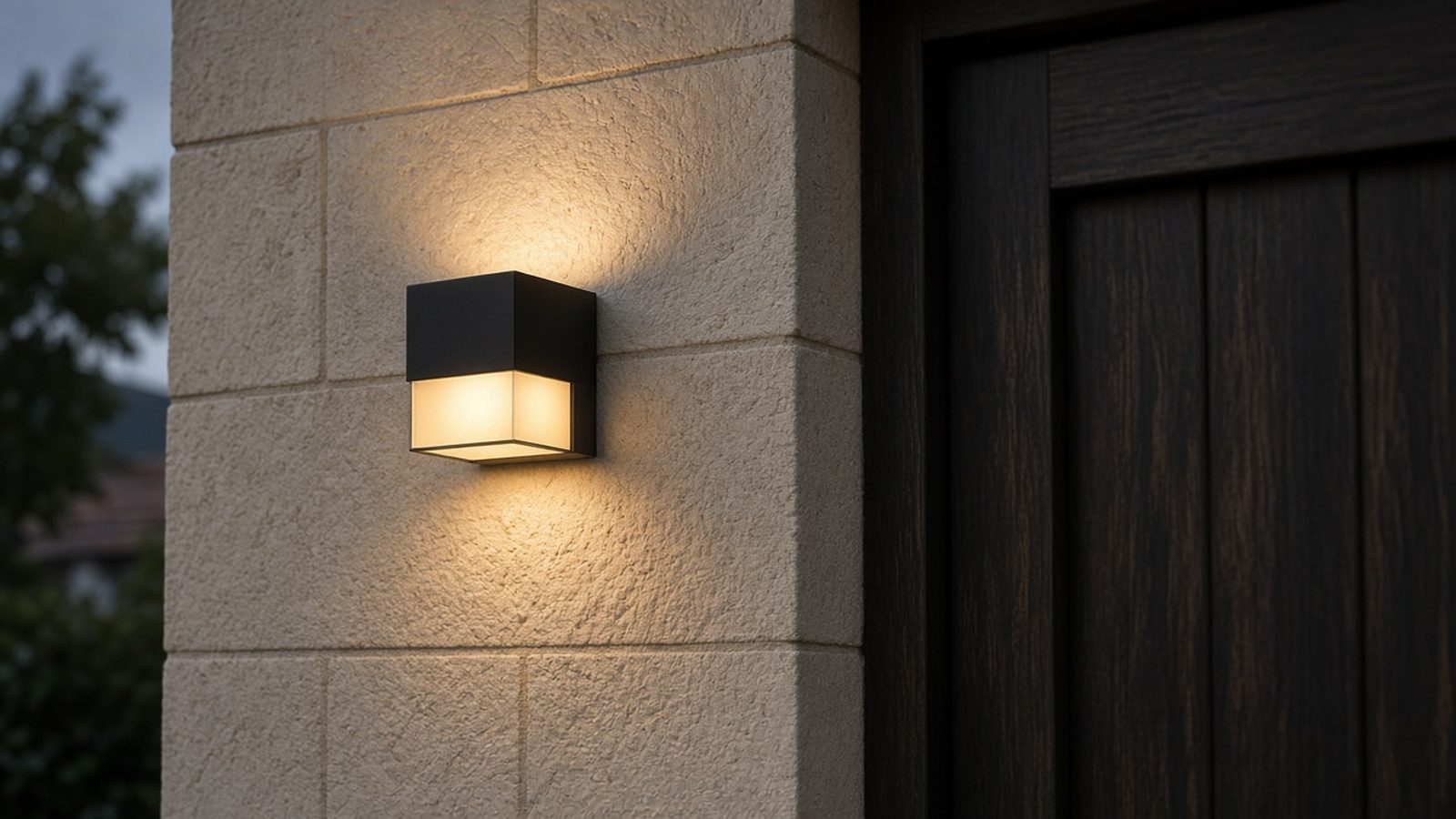
A wall bracket with a curling arm fights a square head on the pillar next to it. The wall range has flat-backed half lanterns that keep the straight lines. PWL 2801 sits flat against the plaster at 13×5, listed in Matte Black with frosted glass. PWL 2806 follows the same idea at 12×6 with clear glass, listed in Raw Grey. For a small marker beside a wicket door or a meter box, PWL 2564 is a 6×7 plate with a leaf motif cut through the face.
The wall lights page asks for one finish across a gate light and a wall light that the road sees together, and that rule matters more with plain shapes because there is no ornament to distract from a mismatch. Set the centre height on the wall with the method in wall lantern mounting height. If the porch on the same elevation needs a pendant, PHL 2624 is a slim square column, 14×5 in Matte Black, on the hanging lights page.
Matte black or Raw Grey on white plaster?
The finish on a listing is the one the casting was photographed in. At the works every catalogue lantern is die-cast and powder coated before it receives the finish named on the quote, so write the finish you want beside each code and confirm it on WhatsApp before the lot goes for coating. Padma powder coats in four finishes: matte black, Raw Grey, antique gold and antique copper.
Against white or off-white plaster, matte black gives the sharpest outline to a box, and it is the finish we usually suggest for a flat contemporary elevation. Raw Grey sits closer in tone to exposed concrete and grey stone cladding, so the head blends into the pillar instead of standing out from it. How black and antique gold behave by day and after dark, and how to keep a batch matched, is in matte black vs antique gold.
Does the head come with a lamp?
The standard holder is B22. Lamps are supplied only where the quote lists them, and a buyer whose electrician brings the lamps can order the casting as an empty housing. Dealers weighing the two can read the trade reasoning under empty housing or glass and LED.
The two low boxes and PWL 2801 have frosted panels that hide the lamp, so each one glows evenly across its faces. Clear glass on PWL 2806 leaves the lamp in view, and the choice between the two is set out in clear or frosted glass.
Can you cast a plainer box to our drawing?
The works makes custom pieces from a physical sample you send, and a custom size needs a lot of 50 pieces or more. That suits a builder repeating one gate across a whole layout. For a single villa, one of the four square catalogue heads in the right size is quicker and avoids the 50-piece minimum. The sample route is described in custom replica from your sample.
How many pieces, and how soon?
Trade pricing starts at 10 pieces. An order of one to five is billed at retail list, and 100 pieces or more is priced as a project. About ten catalogue pieces usually leave Aligarh within four days, while larger lots take one to two weeks. After dispatch, road or rail courier takes 3 to 7 business days for most cities. Prices are ex-works with GST and freight added, and the freight figure is confirmed before the cartons leave, as the shipping page explains.
For a quote, write on WhatsApp to +91 70176 62533 (or by email to padmaenterprises55@gmail.com) and include the cap width in inches, the code and finish for the pillars and the wall, the quantity and the delivery city. All four square heads are photographed in the 2026 catalogue PDF, which you can forward to the client before the order is fixed.