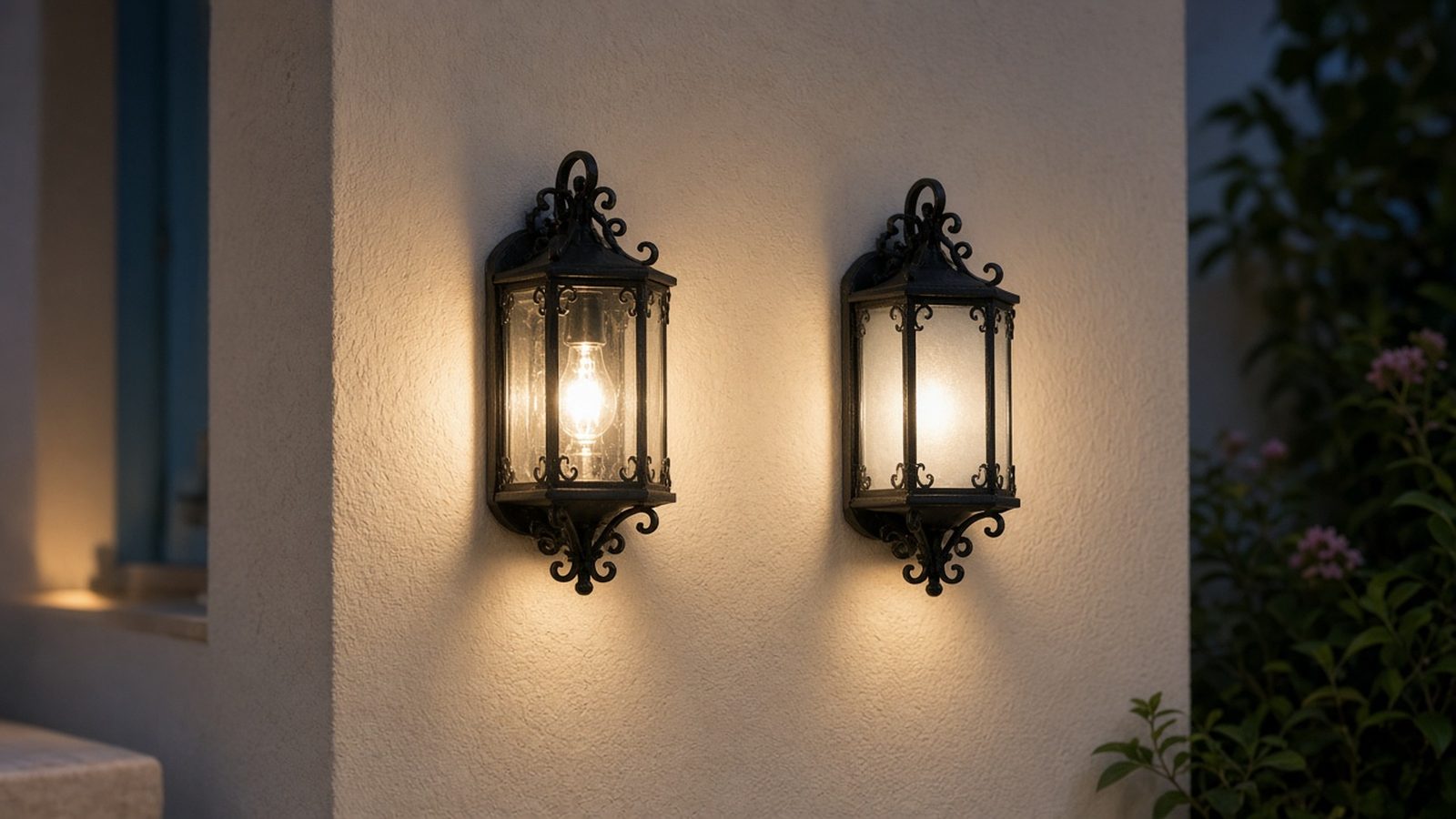
Use frosted glass where people look straight at a lantern from close range or from a moving car. Use clear glass where the fitting sits high or well back and you want the lamp inside to be seen. On a cast aluminium lantern, that choice changes how the fitting looks at night more than most buyers expect, so the glass belongs on the quote line next to the model code and the finish.
Codes for every position on a site are on the gate lights, wall lights and hanging lights pages. The examples below are taken from those ranges.
How each glass behaves after dark
Clear glass lets the eye reach the lamp. From the road you see a bright point inside the frame, and the light leaves the panels with hard edges, so the plaster and the paving around the fitting carry sharper shadows. Seen from a few metres away at eye height, that bright point is the glare neighbours and drivers complain about.
Frosted glass scatters the light across the whole panel. The lantern reads as a soft glowing box and the shape of the lamp disappears. On a matte black or antique frame, the casting then shows up as a dark outline against the glow, which suits ornate patterns. With clear glass, the frame is seen against whatever sits behind it, usually the lamp and the inside of the housing.
Five catalogue codes and the glass in their photos
Each product page photographs the casting with its glass fitted. These five cover both kinds across three ranges. The last column gives height by width in inches, copied from each product page.
| Code | Fitting and finish | Glass in the photo | Listed sizes |
|---|---|---|---|
| PGL 1025 | Hexagonal post-top lantern, Matte Black | Clear | 27×14, 22×12, 17×10 |
| PGL 1037 | Post-top lantern, Antique | Frosted | 32×18, 20×12, 16×7, 13×7 |
| PGL 1066 | Low square pillar light, Raw Grey | Frosted panels | 10×11, 9×8 |
| PWL 2524 | Square wall lantern, Matte Black | Clear | 15×6 |
| PHL 2617 | Hanging lantern, Antique | Frosted | 15×7 |
If a project needs the other glass on a particular code, ask on WhatsApp before the lot is packed. The reply will say what that casting can take, which is better settled on the quote than discovered when the cartons are opened.
One plot, walked from the road to the front door
The example site below is assembled from the kind of briefs that reach the works (no single client's job). It is a corner plot with a pair of gate pillars on the main road, a compound wall along a narrow side lane, a short drive with pole lanterns, a covered porch with a hanging lantern, and a wall lantern on each side of the front door.
Heads that face the road
Drivers approach the gate face-on and people on foot pass within arm's length, so a frosted post-top such as PGL 1037 is the easier choice for each cap. Clear glass on a head like PGL 1025 can still work when the pillars are tall and the gate sits well back from the road, because the lamp then stays above the line of sight. Before choosing glass, size the head against the cap as shown in pillar size to lantern size.
A neighbour's window across the lane
A narrow lane brings the house opposite within a few metres of every boundary fitting. With frosted panels, the family across the lane sees a soft glow from their bedroom window instead of a bare lamp all night. Low walls and run spacing have their own pitfalls, listed in compound wall lantern runs.
Poles along the drive
Pole heads on a residential drive sit near the eye line of a driver and of ground-floor windows, which makes frosted glass the safer default there. Pole height and the gap between poles are worked out in driveway pole spacing, and the heads themselves are on the pole lanterns page.
Looking up at the porch pendant
Anyone waiting at the door looks up into a hanging lantern from a metre or two away. Through clear glass they would be looking at the lamp itself, so a frosted pendant such as PHL 2617 is the better fit here. Drop length and head clearance are covered in how far a porch pendant should hang.
Where clear glass earns its place
The pair of wall lanterns flanking the door is where a clear-glass code like PWL 2524 makes sense, as long as the centre is marked high enough that the lamp stays above a visitor's eyes. The height to mark for clear glass is on wall lantern mounting height.
Glass can change from one zone of the site to the next. Within a single view, such as the gate pillars and the wall lanterns on the boundary beside them, keep one glass so the row looks like one order.
Behind clear glass, the lamp is part of the design
A clear panel puts the lamp on show, so choose its shape and colour temperature as deliberately as the finish. Lamps bought from different shops show up at once behind clear glass: one a shade cooler, another with its LED board in view. Buy the same lamp for every fitting in a row. Frosted glass hides most of those differences.
The standard holder is B22, with another cap fitted only when the quote asks for one, and a bulb goes into the carton only when a line on the quote includes it. At entrances and gates we suggest a warm white lamp in the 2700K to 3000K range, which looks far better through clear glass than a cool daylight one.
Frosted by design, or milky from water
Clear glass that turns cloudy on site is a different problem from frosted glass. Frosted panels have an even, uniform texture on every face from the day they are fitted. A milky or greenish film that builds up on the inside of clear glass means water and dust found a way in at the door or the cap, usually because the door was left unlatched. Clean and dry the inside of the panels, then close the door until the latch catches. The climate side of this is in powder coat and antique in coastal and desert air.
Writing the glass into a trade order
Dealers who glaze locally can order the cast body empty and fit clear or frosted glass from their own stock, which lets one counter offer both looks on the same casting. The trade side of that choice is in empty housing or glass and LED.
For complete fittings, write the glass on each line beside the code, so a lot with frosted heads for the gate and clear lanterns for the door is packed the way the drawing reads. Glass is the fragile part of every carton. If a panel arrives cracked, photograph it and send the photo within forty-eight hours of delivery, since that is the window for reporting transit damage.
To get a quote, send the codes, where each fitting goes on the site, the glass and packing for each line, the quantity, and your city with pincode to WhatsApp +91 70176 62533 or padmaenterprises55@gmail.com. The 2026 catalogue PDF shows every code with its photo, so you can mark clear or frosted against each one before you write.